Mock Drafting: Why?
Better Question: Why the hell not?
FANTASY FOOTBALLFOOTBALL
James Kemp
7/6/202612 min read

When you are a person who takes fantasy football seriously, you hear things like this all the time, and they sound like nails on a chalkboard:
“I do all of my research an hour before I draft.”
“I do all of my research by watching real football.”
“I don’t research. Hell, I don’t even draft. I’ve won championships by autodrafting and that seems to work for me.”
Then you get the rest of us who start in mock drafting in April immediately after the NFL Draft and accumulate hundreds of mock reps over the course of the offseason. People like us are certainly in the minority, but hearing things like this sticks with us. The reason why these pieces of light hearted or unintentional mockery bug us so much largely stems from the fact that we have all seen these strategies (if you would stretch so far as to call them that) work out.
Putting in so much work from April to August just to see your championship go to an autodrafter is one of the most disheartening things we can see happen in fantasy football. Truthfully, nobody should want to see an autodrafted team do well (including the owner of that team) because it defeats the purpose of the game and flies in the face of its spirit, but on those occasions when it does work out, it begs a few questions:
If the lack of a strategy is a valid strategy, why do we mock draft at all? Should we mock draft? Are there really any benefits? If so, can we mock draft too much? I’m here to answer these questions.
Why you shouldn’t autodraft: Understanding the Expert
When thinking about fantasy football from a strategic perspective, many experts tend to think of and compare the player pool to the stock market. It’s not an exact one-to-one (in fact it’s not even close) but given the fact that some of these experts will run dozens of teams over the course of the year (been there) it makes more sense when they say “I’m aiming to have X number of shares of Jeremiyah Love this year.” Unlike the real stock market, there is only one share of each “company” to be bought in a single market, but the “number of shares” or more accurately the “price” of each stock is the piece that is more important and makes more sense. The more valuable the stock, the higher the price. The more valuable the player, the higher their draft position.
This type of thinking is one thing that informs the decisions of experts when it comes time to create fantasy football draft rankings, and there’s nothing inherently wrong with it. However, the way that experts use this thinking to create their rankings systems can vary wildly. Some will use the same kinds of predictive algorithms that some may use to predict stock performance and build their player pool from that. Many of them have developed their own proprietary algorithms to do this, each one weighing variables that impact year-over-year performance differently. More still then tweak what the algorithm spits out based on their own feelings more than actual statistical evidence. Some will then take these results, run them through a manual mock draft of their own creation, and rank the players based off of where they would take each one, given their own ideas on what a “standard” or “average” league is. Some just take a different expert’s rankings, make a few adjustments, and call it their own.
The majority of fantasy ranking experts do one or several of these things on a yearly basis in order to build the rankings that you use, which is why the stock autodraft strategy can be so different from platform to platform. While this sounds like a good basis on which to form a team, it requires a bit of a closer look to understand why it’s not.
First, it’s important to recognize that fantasy football, and therefore fantasy football draft rankings, are not “one size fits all”. When an expert (or increasingly more often now, AI) builds those rankings, they aren’t necessarily doing it for your specific league with your specific ruleset featuring your specific number of teams, scoring system, and roster settings. They are more often than not trying to appeal to an average. These draft rankings are more helpful to everyone if they are built to help the greatest number of people draft a team. They are built to help you, they are not built to do the work for you.
There’s also the problem with experts themselves. The people whose work you are taking at face value (and taking for granted if you autodraft) may tout their own accuracy, but it becomes a bit less attractive when you understand what accuracy actually means. The greatest rankers of all time (and there is a difference between draft rankings and in-season rankings) tend to hover somewhere around 60% accuracy. That is, 60% of the players that they rank finish the season within a certain number of positions from where they were originally ranked. When you are considering just how many players are in the pool, and how big a difference there is from the RB1 to the RB12 (which in 2025 was a whopping 9.3 points per game, even though both finished in the “RB1 Tier”), that accuracy fails to mean much. There is also the fact that most of those "elite" rankers may have one or two great seasons and then never come close again. "Accuracy" means even less when you consider the fact that most rankers fall closer to the 40%-45% accuracy range, and it's far more likely that your platform uses a stock autodraft ranking system that falls into that category than the former.
The bottom line on expert rankings is that they aren’t always objective, they aren’t built on anything foolproof, and while they are extremely helpful if you know how they are supposed to be used, they aren’t an excuse to autodraft a fantasy football team.
But why does autodrafting work sometimes?
The piece of this puzzle that nobody in the fantasy football industry likes to hear is that this is a game of luck. Yes, everything that happens is based on a set of logical potential outcomes that are influenced by trillions of minute factors that aren’t random so much as they are entropic, but even if you reduce those trillions of factors to dozens, the result is still going to appear random. Translation: it’s not luck, but it is.
Every team in your league does not start out their season with an equal chance to win a championship. The teams that you draft will inherently have a greater or lesser chance to win based not just on that previously aforementioned entropy luck, but also on how well you maximized value in your draft through team composition. While in a 12-team league you all may start out at 0-0 with a 8.33% chance to win a championship, drafting a complete team will increase your odds ever so slightly. Avoiding injuries throughout the year will increase those odds further. Hitting on a late round dart throw or scoring a beneficial trade will increase your odds further still. A predicted RB12 becoming the RB1 will increase your odds dramatically. By the time you hit the postseason, you could be an undefeated 14-0 with 50 more points per game than the next highest scoring team, and you still will only have a slightly above 50-60% chance to win any given game you play the rest of the way. Just like in Blackjack, even if you’re counting cards, you’re never guaranteed to win, but you’ve shifted the odds to the point that you’re more likely to.
In short, autodrafted teams win for the same reason that they don’t: luck that isn’t luck but might as well be luck.
If it’s all luck, then why prepare at all? Why mock draft?
Were you listening at all? It’s the odds thing again. Come on, pay attention.
Mock drafting does a few things for you to help you shift the odds in your favor. To be clear, you can’t win anything on draft night, but preparing for the draft can help you build a more organized team that is more likely to capitalize on the odds they’re given.
Scripting the draft: The Decision Tree
If you listen to the Fantasy Footbeer Podcast regularly, you’ll hear me talk about “scripting the draft” and how it isn’t scripting so much as it is familiarizing yourself with potential plans that you can execute. In the same way that NFL teams script plays for certain scenarios, you can expect during various parts of your draft that some players may or may not be available at different times that can shift your odds of success throughout the season to a greater or lesser degree. Unless you have the number one overall pick, you will never know what players will be available, but based on predraft rankings and average draft positions (ADPs) you can give yourself a good idea of what you’re going to see, and form a decision tree based on it.
For example: let’s say you have the number one overall pick this year in a 12 team league. Even in a PPR setting last year, running backs were far more valuable than wide receivers, so you know that of those first 22 picks in between your first and second picks, most of the players taken are likely to be running backs. Taking a wide receiver early could potentially help you corner a shallower market, but you also know that in the RB2 and WR2 tiers, the exponential value drop of receivers flattens more quickly than with running backs, simply because more of them are used and return value.
This knowledge makes your decision tree a pretty simple one to form. You are going to take a running back number one overall because the RB1 is the most valuable player in the game right now, and then knowing that most of the players that are going to be taken over the next two rounds are going to be running backs, you are going to get a higher value wide receiver with the 2.12 pick than even odds say you should. After you take your wide receiver with the 2.12, you then take the next best player available at 3.1 and the decision tree forks even more as tight ends and quarterbacks begin to be taken off the board. If for some reason you’re wrong and the number of receivers and backs taken are more even, it’s no big deal. You get to take another more valuable running back than you were expecting, and the value of the receivers you take the rest of the way will just have a lower ceiling.
Maximizing value at every major position is a great strategy to approach your draft, but it’s significantly more difficult to do this if you are reading from a spreadsheet rather than doing it based on reps you get from mock drafting. This is where the real benefit of mocking comes through. Running likely scenarios through a simulator or doing it in live mock draft rooms can give you muscle memory the same way that running flash cards does. It’s teaching you what to look for while you aren’t rushed for time to think, so that when your friends decide they want to be crazy and opt for a 30 second draft timer during the real thing, you already know the “why” and don’t have to worry about it.
The other benefit of mock drafting is that it’s fun. Fantasy football is supposed to be fun after all, and most people would say that the draft is their favorite part. Why not maximize that fun by making the draft a months long process rather than an hour long one? There are some people who hate fun, as is their right, and I guess they can just autodraft and join us in mid-September.
That all sounds well and good, but why are you mock drafting in April? The rankings change over the summer, so aren’t those wasted reps?
Despite what anybody tells you, the number one reason that people start mock drafting before July is because they’re addicts. Hi, my name is James, I’m a fantasy football addict. It’s not that hard to figure out.
That said, I do believe that there are benefits to starting early. It’s true that the rankings will change as players move teams, rookies show the media things during camp, and injuries pop up or heal in ways we may not have expected them to. The benefit to drafting early is giving yourself the context to understand how and why the rankings change, and how they affect the players in question. Doing this will help you understand how experts form their decisions on player valuation, and whether most of that value comes from the talent of the player themselves, or the situation they find themselves in.
Depending on how an expert views a change, they may look at a player like Kenneth Walker this year as being a landmine or the next breakout superstar. Knowing that scenario and seeing how the rankings move because of it can help you make a decision for yourself on how you value a player like that.
Are there drawbacks to mock drafting? How do I know when I’ve gone too far?
I would generally say that no, there probably aren’t many, if any, drawbacks to mock drafting. However, I do think you can go too far. You can put on a tinfoil hat and convince yourself that you alone have the knowledge and the skill required to see through the lies of the Jedi and pursue an unconventional strategy to great effect. Everybody here has seen Moneyball, and some of us may have even read the book, but memorizing snappy Sorkin dialogue doesn’t mean you’ve seen the code in the Matrix.
Once you start drafting QBs or TEs in the first round, you’re lost in the sauce and it’s time to shut it down for a while. It’s not worth giving yourself an aneurysm on draft day over and then having a panic attack every Sunday because you tie your self worth directly to your fantasy team’s performance. Sometimes your gut really is seeing inefficiencies in the system that you can exploit, and sometimes your gut is just upset and you should take a Tums or something. Either way, there’s usually a reason why the most popular strategies are the most popular.
In conclusion…
If you’re reading this blog you probably already agree with me that mock drafting is generally a good thing and preparing for a fantasy football draft gives your team a better chance to perform well over the course of the season. You probably also know that this is all an entropic clusterfuck basically random and you shouldn’t lose sleep over it, but know that you can actually give yourself better odds by thinking about it and preparing in the correct way.
What we may disagree over is what to do with autodrafters. Personally, I don’t think that anybody wants to autodraft, and we should make every effort to make sure that everybody in our leagues drafts live. Sometimes life just gets in the way and we have to give people grace, knowing that they aren’t doing it simply just to spite you. It is possible, of course, that that's exactly what's happening, in which case you could always try them for treason in an old English court and have their heads put on a pike on the London Bridge. That, however, seems a bit extreme for this particular circumstance, and plane tickets to England are crazy expensive right now. If your godlike fantasy football knowledge that you acquired from a summer (and spring) of mock drafting intimidates them to that degree, then let them.
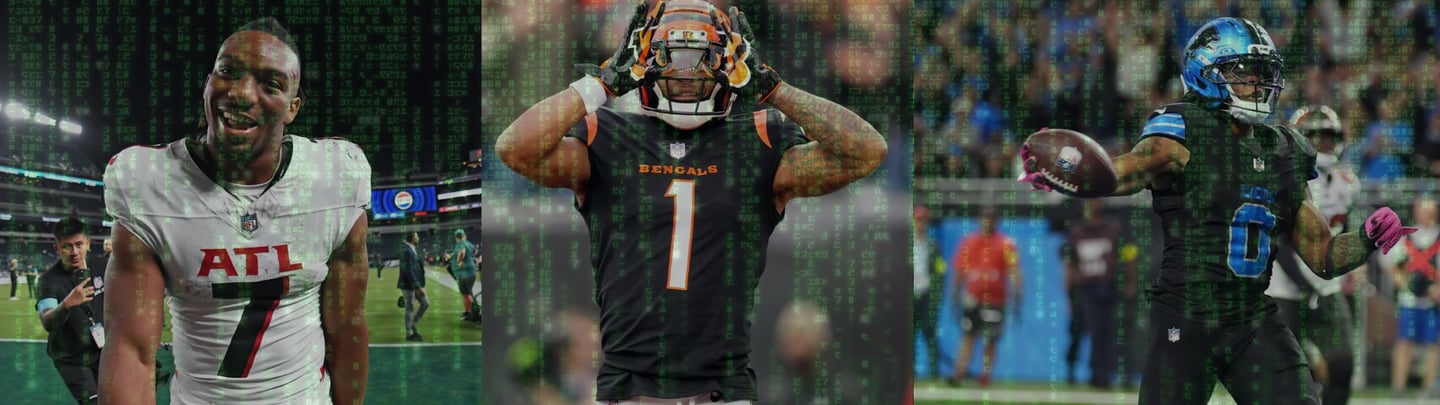
It’s not like they’re going to turn to an AI to run their team, right? AI can't actually make good fantasy football decisions, right?...Right?...That can’t happen, the IBM Watson fantasy thing was a failure, RIGHT???? THE MACHINES AREN’T TAKING OVER AND WE’RE NOT IN THE MATRIX, RIGHT??????????????
Anyway, thanks for reading, happy mock draft season!

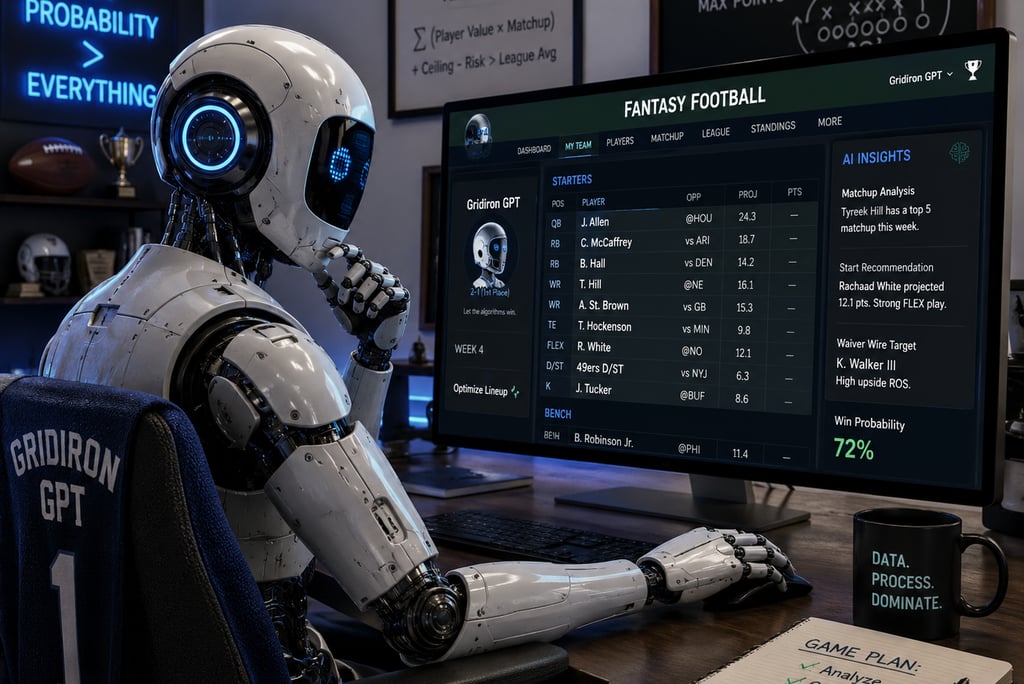
I asked ChatGPT to make an image of "an AI playing fantasy football". It literally put Justin Tucker on it's team who hasn't been in the NFL since 2024, and is targeting Kenneth Walker on waivers, who is going to be a second round pick this year. Even if it didn't suck, if you use AI to make your fantasy football decisions for you, you hate fun and are seriously the worst.

It doesn't have anything to do with AI...right?
The Talented Mr. Roto doesn't have a silver bullet for you.